Required Minimum Distributions (RMDs): Everything You Need to Know
Once you reach age 73, the IRS requires you to take annual withdrawals from most retirement accounts. Understanding RMD rules, calculation methods, deadlines, and strategies helps you avoid costly penalties and minimize taxes in retirement.
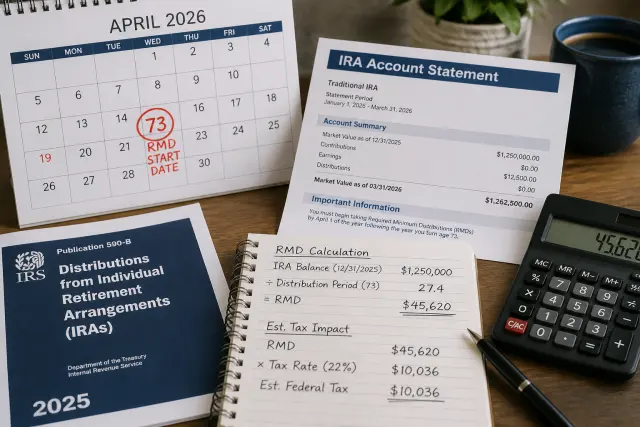
After decades of tax-deferred growth in retirement accounts, the IRS eventually requires you to start taking money out. These mandatory withdrawals — called Required Minimum Distributions (RMDs) — prevent pre-tax retirement savings from accumulating tax-free indefinitely. Understanding when RMDs start, how they are calculated, the consequences of missing them, and the strategies available to manage their tax impact is essential for anyone approaching or in retirement.
Which Accounts Require RMDs?
Distribution and catch-up rules are indexed and can vary by account type, age and employment status. Verify the current requirement in the official IRS guidance before acting.
Distribution and catch-up rules are indexed and can vary by account type, age and employment status. Verify the current requirement in the official IRS guidance before acting.
Distribution and catch-up rules are indexed and can vary by account type, age and employment status. Verify the current requirement in the official IRS guidance before acting.
Distribution and catch-up rules are indexed and can vary by account type, age and employment status. Verify the current requirement in the official IRS guidance before acting.
Distribution and catch-up rules are indexed and can vary by account type, age and employment status. Verify the current requirement in the official IRS guidance before acting.
Distribution and catch-up rules are indexed and can vary by account type, age and employment status. Verify the current requirement in the official IRS guidance before acting.
Distribution and catch-up rules are indexed and can vary by account type, age and employment status. Verify the current requirement in the official IRS guidance before acting.
Distribution and catch-up rules are indexed and can vary by account type, age and employment status. Verify the current requirement in the official IRS guidance before acting.
Distribution and catch-up rules are indexed and can vary by account type, age and employment status. Verify the current requirement in the official IRS guidance before acting.
Distribution and catch-up rules are indexed and can vary by account type, age and employment status. Verify the current requirement in the official IRS guidance before acting.
Distribution and catch-up rules are indexed and can vary by account type, age and employment status. Verify the current requirement in the official IRS guidance before acting.
When Do RMDs Begin?
Distribution and catch-up rules are indexed and can vary by account type, age and employment status. Verify the current requirement in the official IRS guidance before acting.
Distribution and catch-up rules are indexed and can vary by account type, age and employment status. Verify the current requirement in the official IRS guidance before acting.
Distribution and catch-up rules are indexed and can vary by account type, age and employment status. Verify the current requirement in the official IRS guidance before acting.
Summary for current planning:
- Born before July 1, 1949 (turned 70½ before 2020): RMDs started at 70½
- Born July 1, 1949 – December 31, 1950: RMDs started at age 72
- Born January 1, 1951 – December 31, 1959: RMDs start at age 73
- Born January 1, 1960 or later: RMDs start at age 75 (starting in 2033)
For most current retirement planners under age 60, age 73 is the working planning assumption for when RMDs begin, with a potential further delay to 75 depending on birth year.
How to Calculate Your RMD
Your annual RMD amount is calculated using a straightforward formula:
RMD = Prior Year-End Account Balance ÷ Life Expectancy Factor
Step 1 — Get the prior year-end account balance. Your financial institution reports your December 31 account balance of the prior year on IRS Form 5498. If you have multiple IRAs at different institutions, you sum all balances for IRA RMD calculation purposes. (401k accounts are calculated separately per account.)
Step 2 — Find your life expectancy factor. The IRS provides tables in Publication 590-B. Most account owners use the Uniform Lifetime Table — Table III. A 73-year-old has a distribution period of 26.5; a 74-year-old has 25.5; a 75-year-old has 24.6; and so on, decreasing by approximately one each year. The table is designed so that RMDs gradually increase as a percentage of the account balance as you age.
Step 3 — Divide. Divide the prior December 31 balance by the factor from Table III. An account worth $500,000 on December 31 for a 73-year-old: $500,000 ÷ 26.5 = $18,868 minimum withdrawal required for the year.
Exception — spouse beneficiary rule: If your sole designated beneficiary is your spouse and your spouse is more than 10 years younger than you, you may use the more favorable Joint Life and Last Survivor Table (Table II), which produces a lower distribution factor (longer joint life expectancy) and therefore a smaller RMD. This exception only applies to the sole beneficiary situation with an age differential of more than 10 years.
Distribution and catch-up rules are indexed and can vary by account type, age and employment status. Verify the current requirement in the official IRS guidance before acting.
Distribution and catch-up rules are indexed and can vary by account type, age and employment status. Verify the current requirement in the official IRS guidance before acting.
Distribution and catch-up rules are indexed and can vary by account type, age and employment status. Verify the current requirement in the official IRS guidance before acting.
RMD Deadlines
Distribution and catch-up rules are indexed and can vary by account type, age and employment status. Verify the current requirement in the official IRS guidance before acting.
Distribution and catch-up rules are indexed and can vary by account type, age and employment status. Verify the current requirement in the official IRS guidance before acting.
Distribution and catch-up rules are indexed and can vary by account type, age and employment status. Verify the current requirement in the official IRS guidance before acting.
Penalties for Missing RMDs
Distribution and catch-up rules are indexed and can vary by account type, age and employment status. Verify the current requirement in the official IRS guidance before acting.
- Prior law: 50% excise tax on the shortfall
- SECURE 2.0 current law: 25% excise tax on the shortfall, reduced to 10% if the failure is corrected within a two-year correction window
Example: You were required to take $20,000 as your RMD but only took $15,000 — a $5,000 shortfall. At the 25% rate, the excise tax is $1,250. If you correct the shortfall within two years by taking the missed amount, the tax reduces to $500 (10%).
The IRS Form 5329 is used to report the missed RMD and calculate the excise tax. The IRS also has a history of granting waivers for first-time RMD failures or reasonable-cause situations — applying for a waiver via a letter attached to Form 5329 has historically been successful for genuine mistakes.
Strategies to Manage RMD Tax Impact
RMDs create taxable income that cannot be avoided but can be strategically managed to minimize total lifetime taxes:
Roth conversions before RMD age. The years between retirement and age 73 (when RMDs begin) represent a potentially valuable window for Roth conversions. If you retire at 65 and do not yet have Social Security or RMD income, your taxable income may be temporarily low. Converting a portion of your traditional IRA to Roth each year during this window — paying taxes at today's (relatively lower) rate — reduces the future traditional IRA balance and thus reduces future RMDs. This strategy explicitly trades paying taxes today to avoid paying (potentially higher) taxes on larger RMDs later.
Strategic withdrawal sequencing. In early retirement years before RMDs begin, drawing income from traditional IRAs and 401(k)s rather than Roth accounts gradually depletes the pre-tax balance — reducing future RMDs. This sequencing decision involves multiple variables (current and projected tax rates, Social Security timing, Medicare premium surcharges) and often benefits from professional modeling.
Distribution and catch-up rules are indexed and can vary by account type, age and employment status. Verify the current requirement in the official IRS guidance before acting.
Distribution and catch-up rules are indexed and can vary by account type, age and employment status. Verify the current requirement in the official IRS guidance before acting.
Qualified Charitable Distributions (QCDs)
Distribution and catch-up rules are indexed and can vary by account type, age and employment status. Verify the current requirement in the official IRS guidance before acting.
Counts toward your RMD. A QCD satisfies your RMD requirement for the year, meaning it counts as your required distribution even though you receive no cash.
Excluded from taxable income. Unlike a regular IRA distribution where you take the money and then donate it to charity, a QCD is excluded from your gross income entirely. You receive no cash but also pay no income tax on the distribution.
No itemization required. Because the QCD is excluded from income rather than taken as a deduction, you don't need to itemize deductions to receive the full benefit. For the approximately 90% of Americans who now take the standard deduction, charitable giving through regular cash donations provides no income tax benefit — but QCDs provide a dollar-for-dollar income reduction.
Example: A 74-year-old has a $25,000 RMD requirement. She makes a $10,000 QCD directly from her IRA to her university. The $10,000 counts toward her RMD (so she only needs to take $15,000 more in regular distributions), and the $10,000 is completely excluded from her taxable income — saving her approximately $2,200 in federal taxes at the 22% bracket.
Distribution and catch-up rules are indexed and can vary by account type, age and employment status. Verify the current requirement in the official IRS guidance before acting.
Inherited IRA RMD Rules
Distribution and catch-up rules are indexed and can vary by account type, age and employment status. Verify the current requirement in the official IRS guidance before acting.
Distribution and catch-up rules are indexed and can vary by account type, age and employment status. Verify the current requirement in the official IRS guidance before acting.
Distribution and catch-up rules are indexed and can vary by account type, age and employment status. Verify the current requirement in the official IRS guidance before acting.
Distribution and catch-up rules are indexed and can vary by account type, age and employment status. Verify the current requirement in the official IRS guidance before acting.
SECURE 2.0 Changes
Distribution and catch-up rules are indexed and can vary by account type, age and employment status. Verify the current requirement in the official IRS guidance before acting.
Distribution and catch-up rules are indexed and can vary by account type, age and employment status. Verify the current requirement in the official IRS guidance before acting.
Distribution and catch-up rules are indexed and can vary by account type, age and employment status. Verify the current requirement in the official IRS guidance before acting.
Distribution and catch-up rules are indexed and can vary by account type, age and employment status. Verify the current requirement in the official IRS guidance before acting.
Distribution and catch-up rules are indexed and can vary by account type, age and employment status. Verify the current requirement in the official IRS guidance before acting.
Future age increase: The RMD starting age will increase to 75 in 2033 for those born on January 1, 1960 or later.
RMDs are an inevitable feature of retirement accounts that hold pre-tax savings. They cannot be permanently avoided — only managed strategically to minimize their tax cost. The most impactful strategies — Roth conversions during the pre-RMD window, QCDs for charitably inclined retirees, and careful withdrawal sequencing — can save tens of thousands of dollars in lifetime taxes versus an unmanaged approach. Understanding these rules early enough to implement strategies is significantly more valuable than learning them after the first RMD arrives.
Sources, scope, and review
Last editorial review: October 20, 2026. This page provides general educational information, not individualized investment, tax, legal, or financial advice. Past performance does not predict future results.
Editorial responsibility: Juarez Santos. Background provided by the site owner: financial agent and real-estate management. This background does not replace individualized advice or a credentialed specialist review. When a qualified independent reviewer contributes to a page, that reviewer and their role must be identified on that page.
Disclosure requirement: Before publication, display any material affiliate, advertising, or commercial relationship relevant to this page. Do not state that a professional specialist reviewed an article unless that review can be documented.
Frequently Asked Questions
What happens if I don't take my RMD?
Missing an RMD or taking less than required results in a 25% excise tax on the amount that should have been withdrawn (reduced to 10% if corrected within two years). For example, missing a $20,000 RMD triggers a $5,000 tax. The IRS also has historically granted waivers for first-time failures with reasonable cause — submit Form 5329 with an attached waiver request letter explaining the circumstances.
Do Roth IRAs have required minimum distributions?
No. Roth IRAs are exempt from RMDs during the original owner's lifetime. This is one of the Roth IRA's most valuable features — funds can grow tax-free indefinitely without forced distributions. As of 2024, Roth 401(k)s are also exempt from RMDs (SECURE 2.0 change). Inherited Roth IRAs are subject to different rules — most non-spouse beneficiaries must distribute the inherited Roth IRA within 10 years, though the distributions remain income-tax-free.
Can I take more than my required minimum distribution?
Yes. You can always withdraw more than the required minimum distribution. The RMD is only a floor, not a ceiling. Additional withdrawals above the RMD are taxable as ordinary income but carry no penalty. However, excess withdrawals from one year cannot be applied toward the following year's RMD requirement — each year's RMD must be met independently.
Can I use my RMD to reduce my taxes through charitable giving?
Yes — through a Qualified Charitable Distribution (QCD). If you are 70½ or older, you can direct up to $105,000 (2024, indexed for inflation) directly from your IRA to a qualified charity. The QCD counts toward your RMD, is excluded from your taxable income, and requires no itemization. This is one of the most tax-efficient charitable giving strategies available and can save thousands in taxes annually for retirees who give to charity.