Best ETFs for Beginners
Exchange-traded funds make it easy to own hundreds of stocks at once with a single purchase. This guide breaks down the best ETFs for beginners, what to look for, and exactly how to build a solid starter portfolio.
If you want to invest in the stock market without spending hours researching individual companies, exchange-traded funds — ETFs — are the answer. A single ETF can give you instant ownership of hundreds or even thousands of stocks, diversified across sectors and geographies, all for the price of one share and a tiny annual fee.
This guide covers everything a beginner needs to know about ETFs: what they are, why they outperform most actively managed funds, which metrics matter when comparing options, and the specific funds that financial professionals and experienced investors most commonly recommend as starting points.
Table of Contents
- What Is an ETF?
- ETFs vs. Mutual Funds
- How to Evaluate an ETF
- Top ETFs for Beginners
- How to Build a Beginner ETF Portfolio
- Common ETF Mistakes to Avoid
What Is an ETF?
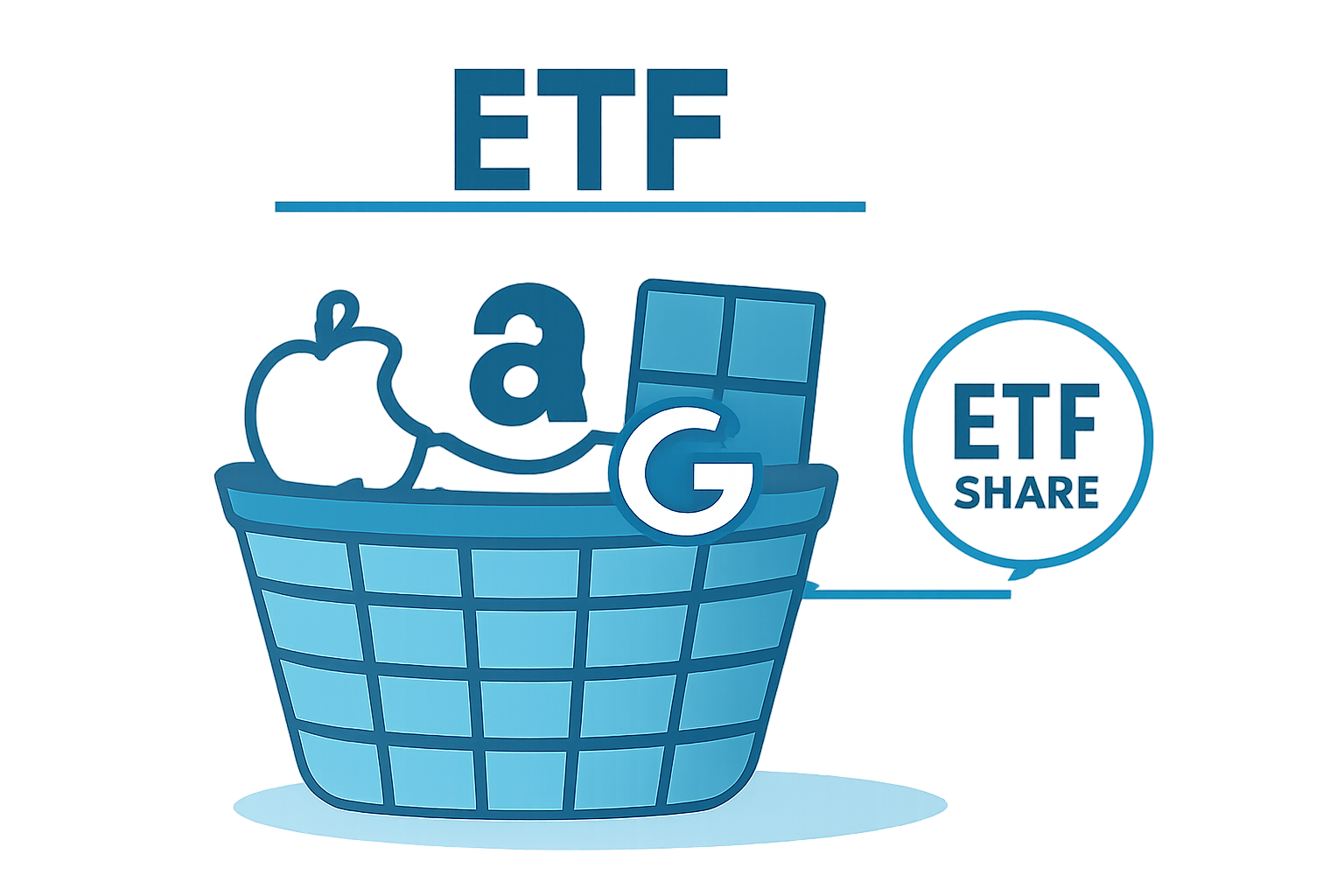
An ETF, or exchange-traded fund, is a basket of securities — stocks, bonds, or other assets — that trades on a stock exchange just like a single stock. When you buy one share of an ETF, you are buying a proportional stake in every security held inside that fund.
For example, the Vanguard S&P 500 ETF (VOO) holds all 500 stocks in the S&P 500 index. Buying one share of VOO is equivalent to owning tiny fractions of Apple, Microsoft, Amazon, Nvidia, Berkshire Hathaway, and 495 other companies — all in one transaction. The ETF automatically rebalances its holdings whenever the underlying index changes, so you never have to manage individual positions.
Most popular ETFs are passive index funds: they aim to replicate the performance of a specific market index rather than beat it. This approach keeps costs extremely low because there is no team of analysts actively picking stocks. The fund simply holds what the index holds, in the same proportions.
How ETFs Trade
Unlike traditional mutual funds, which price once per day after the market closes, ETFs trade throughout the day on exchanges at prices determined by supply and demand. You buy and sell ETF shares the same way you buy and sell individual stocks — through a brokerage account, using market orders or limit orders. This intraday liquidity gives you more flexibility, though for long-term buy-and-hold investors it rarely matters in practice.
ETFs vs. Mutual Funds
ETFs and mutual funds are both pooled investment vehicles, but they differ in important ways that matter to beginners:
| Feature | ETF | Mutual Fund |
|---|---|---|
| Trading | Intraday on exchange | Once daily after market close |
| Minimum investment | Price of one share (or fractional) | Often $1,000–$3,000 |
| Expense ratios | Often 0.03%–0.20% | Varies widely; active funds often 0.5%–1.5% |
| Tax efficiency | Generally more tax-efficient | Less tax-efficient due to redemption structure |
| Automatic investing | Supported at most brokers | Built-in at many fund companies |
For most beginners, ETFs win on cost, accessibility, and tax efficiency. The lower investment minimums are especially helpful when you are just starting out and investing smaller amounts. With fractional shares now available at most major brokers, you can buy a piece of any ETF for as little as $1.
How to Evaluate an ETF
Not all ETFs are created equal. Before buying any fund, examine these five key metrics:
1. Expense Ratio
The expense ratio is the annual fee charged by the fund, expressed as a percentage of your investment. A 0.03% expense ratio means you pay $0.30 per year for every $1,000 invested. A 1.00% ratio costs $10 per year per $1,000 — and that gap compounds dramatically over time. For broad market index ETFs, anything above 0.20% is hard to justify. The best funds charge 0.03%–0.10%.
2. Assets Under Management (AUM)
Larger funds are generally safer and more liquid. A fund with $50 billion in assets is extremely unlikely to close; a fund with $10 million in assets might. Look for ETFs with at least $1 billion in AUM. The funds on this list all exceed that threshold by a wide margin.
3. Tracking Error
Tracking error measures how closely an ETF follows its benchmark index. A fund that consistently lags its index by more than its expense ratio is underperforming — something is wrong with its management or replication strategy. The best index ETFs have tracking errors of essentially zero.
4. Trading Volume and Bid-Ask Spread
High trading volume means narrow bid-ask spreads — the difference between the buy price and the sell price. Wide spreads cost you money every time you trade. Popular funds like VOO and VTI have extremely tight spreads, making them very cost-effective to trade.
5. Index It Tracks
Two ETFs with similar names may track very different indexes. Always check exactly which index the fund tracks and what it includes. An "S&P 500 ETF" and a "Large-Cap U.S. ETF" may look similar but could hold different companies with different weightings.
Top ETFs for Beginners
The following ETFs represent the most widely recommended starting points for new investors. All have low expense ratios, massive assets under management, and track well-established indexes.
For Total U.S. Stock Market Exposure
Vanguard Total Stock Market ETF (VTI) — Expense ratio: 0.03%
VTI tracks the CRSP US Total Market Index, giving you exposure to virtually every publicly traded U.S. stock — large-cap, mid-cap, and small-cap. With over 3,800 holdings and roughly $1.5 trillion in assets, it is the broadest, most comprehensive U.S. stock market fund available. For investors who want to own the entire U.S. market in one fund, VTI is the gold standard.
Fidelity ZERO Total Market Index Fund (FZROX) — Expense ratio: 0.00%
Available only at Fidelity, FZROX charges absolutely no fee. The trade-off is that it tracks a proprietary Fidelity index rather than an industry-standard one, and it is not available at other brokers. For Fidelity customers who plan to hold long-term, the zero expense ratio is a genuine advantage.
For S&P 500 Exposure
Vanguard S&P 500 ETF (VOO) — Expense ratio: 0.03%
VOO is one of the most popular investments in the world. It tracks the S&P 500, holding 500 of the largest U.S. companies by market cap. The S&P 500 has returned an average of roughly 10% per year over the past century, and VOO replicates that performance almost perfectly at nearly zero cost.
iShares Core S&P 500 ETF (IVV) — Expense ratio: 0.03%
Managed by BlackRock, IVV is functionally identical to VOO — same index, same cost, similar performance. The main difference is that IVV is available at more brokers without any restrictions and has slightly different dividend payment timing. Either fund is an excellent core holding.
SPDR S&P 500 ETF Trust (SPY) — Expense ratio: 0.09%
SPY was the first ETF ever created in the United States, launched in 1993. It is by far the most actively traded ETF in the world, making it extremely liquid. However, its expense ratio (0.09%) is three times that of VOO and IVV. For long-term buy-and-hold investors, VOO or IVV is the better choice. SPY is better suited for traders who need maximum liquidity.
For Bond Exposure
Vanguard Total Bond Market ETF (BND) — Expense ratio: 0.03%
BND provides exposure to the entire U.S. investment-grade bond market — government bonds, corporate bonds, and mortgage-backed securities. Adding BND to a stock-heavy portfolio reduces volatility and provides income from interest payments. Many beginner portfolios start with 80–90% VTI and 10–20% BND.
For International Exposure
Vanguard Total International Stock ETF (VXUS) — Expense ratio: 0.07%
VXUS holds stocks from developed and emerging markets outside the United States — Europe, Japan, Canada, China, and dozens of other countries. Adding international exposure to a U.S.-only portfolio reduces the risk of underperformance if the U.S. market lags global markets for an extended period, as it has during several historical periods.
How to Build a Beginner ETF Portfolio
With the funds above, you can build a complete, globally diversified portfolio with just two or three ETFs. Here are three approaches, from simplest to most diversified:
The One-Fund Portfolio
Buy VTI (or VOO) and nothing else. This single fund gives you exposure to hundreds of U.S. companies across every sector. It is not perfectly diversified — it excludes international stocks and bonds — but it is infinitely better than not investing at all, and it requires almost no maintenance. This approach is ideal for investors in their 20s and early 30s with long time horizons who want maximum simplicity.
The Two-Fund Portfolio
Combine VTI with BND. The ratio depends on your risk tolerance and time horizon. A common starting allocation for younger investors is 90% VTI / 10% BND. As you approach retirement, gradually shift more toward BND to reduce volatility. This two-fund combination covers the entire U.S. stock and bond markets at very low cost.
The Three-Fund Portfolio
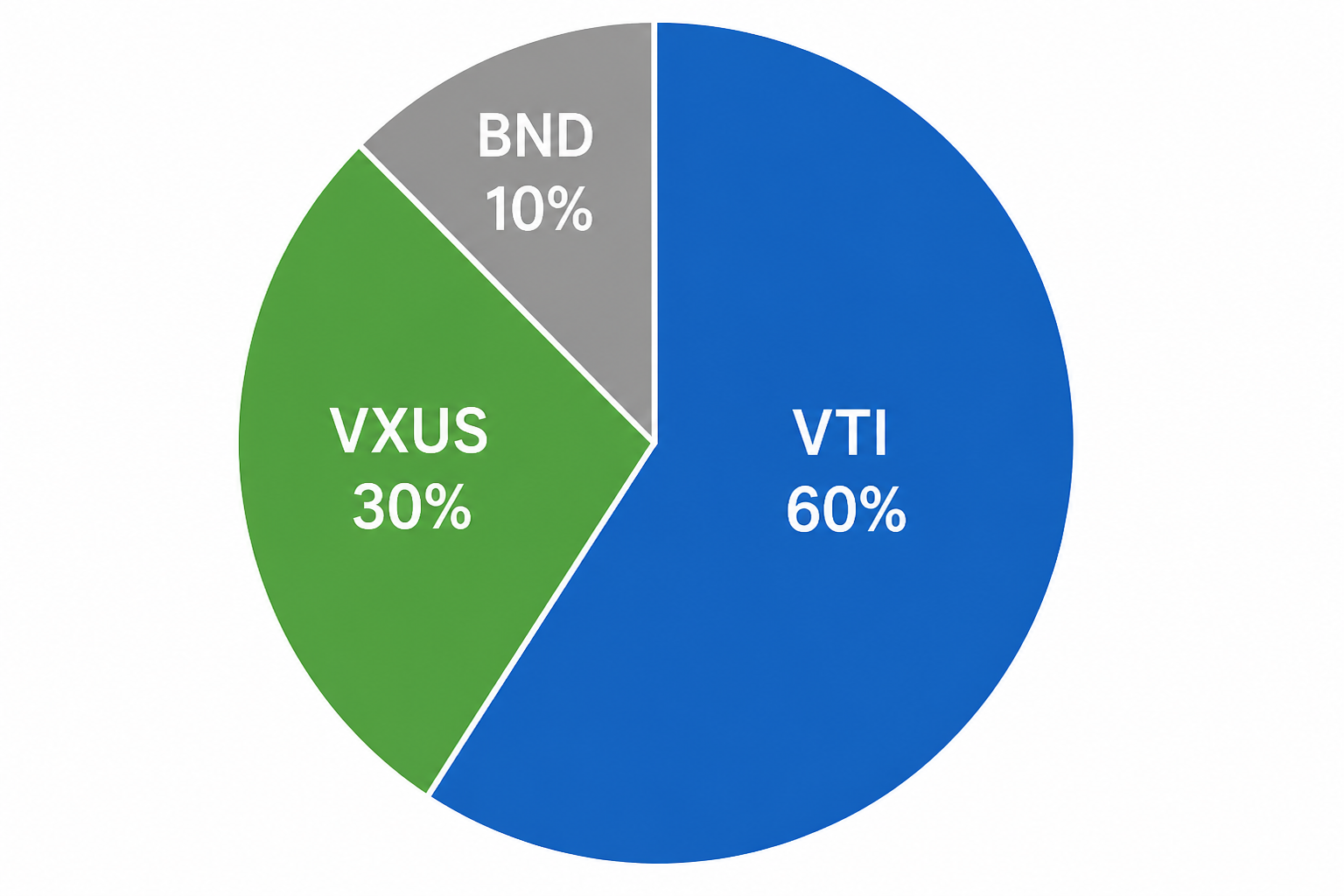
Add VXUS to the two-fund portfolio for international diversification: roughly 60% VTI / 30% VXUS / 10% BND. This combination covers nearly every publicly traded stock and bond in the world. It is the approach recommended by many fee-only financial advisors and championed by Vanguard's own founder, Jack Bogle (minus the international component — Bogle famously preferred U.S.-only). All three funds from Vanguard combined cost just 0.04% on average.
How Much to Invest and When
Open a Roth IRA or brokerage account at Fidelity, Schwab, or Vanguard and set up automatic monthly purchases. The amount matters less than the consistency. Invest what you can afford each month without disrupting your emergency fund or paying high-interest debt. Use dollar-cost averaging — invest the same dollar amount on a fixed schedule regardless of market conditions — rather than trying to time the market. Over decades, this approach builds substantial wealth with minimal effort.
Common ETF Mistakes to Avoid
Even simple index ETF investing has pitfalls. Here are the ones that most commonly hurt beginning investors:
- Buying too many ETFs: More funds do not mean more diversification if they overlap significantly. Owning VOO, VTI, and an S&P 500 mutual fund is not three-times diversified — they all hold the same stocks. Stick to two or three complementary funds that cover different asset classes or geographies.
- Chasing thematic or sector ETFs too early: Clean energy ETFs, cannabis ETFs, AI ETFs, and similar niche products attract attention but carry far more risk than broad market funds. They may outperform brilliantly during their boom phase and collapse just as dramatically during busts. Build your core with broad market ETFs before adding any satellite positions.
- Ignoring the expense ratio: Some ETFs marketed to retail investors charge 0.5%–1.0% for strategies that differ only marginally from a 0.03% index fund. Check the expense ratio of every fund you consider. In a portfolio earning 7% per year, a 1% fee consumes more than 14% of your real return.
- Selling during volatility: ETF prices fluctuate daily, sometimes dramatically. The investors who build the most wealth through ETFs are those who automate contributions, ignore short-term price swings, and never sell during market panics. Your ETF's 30% paper loss during a bear market is only a real loss if you sell.
- Forgetting about taxes in taxable accounts: In a taxable brokerage account (not an IRA or 401k), you owe capital gains taxes when you sell shares at a profit. Holding ETFs long-term (over one year) qualifies you for the lower long-term capital gains rate. Avoid frequent trading that generates short-term capital gains taxed as ordinary income.
- Not automating contributions: The biggest risk for beginner investors is not investing at all because they forget or feel the moment is not right. Setting up automatic monthly contributions removes the decision entirely and ensures your wealth-building happens regardless of market sentiment or personal motivation levels.
ETFs are arguably the most powerful tool available to the everyday American investor. Low costs, instant diversification, easy access, and decades of strong performance make them the default recommendation of financial professionals across the spectrum. Start with VTI or VOO, automate your contributions, and let compound growth do the work over time. Your future self will be grateful.
Frequently Asked Questions
What is the best ETF for a complete beginner?
For most beginners, the Vanguard Total Stock Market ETF (VTI) or the Vanguard S&P 500 ETF (VOO) are the best starting points. Both have expense ratios of just 0.03%, track well-established indexes, and provide instant diversification across hundreds of U.S. companies. If you invest at Fidelity, their ZERO Total Market Index Fund (FZROX) costs absolutely nothing. Start with one of these core funds before adding anything else.
How much money do I need to start investing in ETFs?
Most major brokers allow you to buy ETFs with no account minimum, and fractional shares mean you can invest any dollar amount — even $1. Practically speaking, starting with at least $50–$100 makes more sense given the mechanics of regular investing, but there is no barrier preventing you from starting smaller. The important thing is to begin and make contributing a consistent habit.
Is it better to invest in one ETF or several?
For most beginners, one to three ETFs is ideal. A single broad market fund like VTI already holds thousands of stocks and is more diversified than most actively managed portfolios. Adding a bond ETF (BND) and an international ETF (VXUS) covers the entire global market. Owning 10 or 20 ETFs typically adds complexity without meaningful diversification benefits, since many ETFs overlap heavily in their holdings.
Are ETFs safer than buying individual stocks?
Yes, in practical terms. An ETF that holds 500 companies cannot go to zero unless all 500 companies go bankrupt simultaneously — essentially impossible. An individual stock can go to zero if the company fails. ETFs still carry market risk — your portfolio value will fluctuate — but the diversification inherent in index ETFs eliminates the company-specific risk that comes with holding individual stocks.
Can I lose all my money in an ETF?
Losing your entire investment in a broad market ETF like VTI or VOO is extremely unlikely — it would require the entire U.S. economy to collapse permanently. However, ETF values do fall significantly during bear markets — the S&P 500 dropped roughly 50% in 2008–2009 and about 34% in early 2020. These declines are temporary for investors who stay the course. The key rule: only invest money you will not need for at least three to five years.