Backdoor Roth IRA: How High Earners Access Tax-Free Growth
High earners above the Roth IRA income limits can still access tax-free retirement growth through the backdoor Roth IRA strategy. This guide explains the two-step process, the critical pro-rata rule, how to avoid common mistakes, and the mega backdoor Roth option.
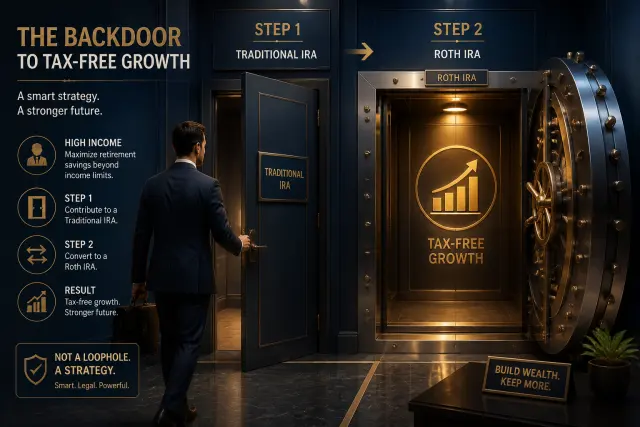
Contribution limits, eligibility and catch-up rules are indexed. Check the current IRS guidance for the tax year before contributing.
This guide explains exactly how the backdoor Roth IRA works, the critical tax rules you must understand before executing it, and how to avoid the costly mistakes that catch many practitioners off guard.
Why High Earners Need the Backdoor
Rules, limits, eligibility and benefit calculations change by tax year and individual circumstances. Confirm the current requirement with the official source before acting.
For dual-income professional households — physicians, attorneys, tech professionals, corporate executives — these thresholds are crossed early in their careers and permanently afterward. Without the backdoor strategy, these high earners would be permanently locked out of the Roth IRA's significant tax advantages despite these benefits being most valuable to them (since they are in the highest tax brackets).
The backdoor Roth IRA emerged from the interaction of two tax rules: (1) anyone can make a non-deductible contribution to a Traditional IRA regardless of income, and (2) anyone can convert Traditional IRA funds to a Roth IRA at any time, regardless of income. The 2010 elimination of the $100,000 income limit on Roth conversions opened the backdoor permanently. Congress has explicitly discussed closing it and has not done so — it remains a legal and widely used strategy employed by millions of high-income Americans annually.
The Two-Step Process
The backdoor Roth IRA requires two distinct transactions:
Step 1 — make a nondeductible traditional IRA contribution if appropriate: For 2026, the combined IRA contribution limit is $7,500 ($8,600 if age 50 or older). Deductibility, Roth eligibility and the tax effect of a conversion depend on income, filing status and all traditional IRA balances. Review the IRS 2026 limits and obtain tax advice before contributing or converting.
Step 2 — document any conversion: A conversion can have tax and reporting consequences, including the pro-rata rule when pre-tax IRA balances exist. Keep records and consult the relevant IRS forms and instructions; do not assume a conversion produces little or no tax.
If executed promptly — contributing to the Traditional IRA and converting to the Roth IRA within days, while earnings are effectively zero — the entire transaction is accomplished with minimal or no additional tax cost. The funds then reside in the Roth IRA to grow tax-free and be withdrawn tax-free in retirement.
The Pro-Rata Rule: The Most Important Tax Concept
The pro-rata rule is the critical concept that determines whether your backdoor Roth conversion is clean (no taxes owed) or messy (partially or substantially taxable). Understanding it is non-negotiable before executing the strategy.
The IRS does not allow you to choose which IRA dollars are being converted. Instead, it treats all your Traditional IRA funds across all accounts as a single pool when calculating the taxable portion of a conversion. The tax owed is proportional to the ratio of pre-tax funds to total IRA funds.
Example of the pro-rata rule with existing IRA funds:
Suppose you have $93,000 in a pre-tax Traditional IRA (from old 401k rollover) and you make a $7,000 non-deductible contribution, bringing your total Traditional IRA to $100,000. When you convert $7,000 to Roth, the IRS calculates:
- After-tax (non-deductible) basis: $7,000 (7% of total)
- Pre-tax funds: $93,000 (93% of total)
- Tax-free portion of $7,000 conversion: $7,000 × 7% = $490
- Taxable portion: $7,000 × 93% = $6,510
In this example, what you hoped would be a tax-free conversion actually generates $6,510 in ordinary taxable income. For an investor in the 37% bracket, that is $2,409 in unexpected taxes — almost entirely defeating the purpose of the backdoor strategy.
The pro-rata rule applies to all your Traditional IRA accounts combined: Traditional IRA, SEP-IRA, and SIMPLE IRA balances are all aggregated. Roth IRA balances and 401(k)/403(b) balances (even from former employers) are excluded from this calculation.
Solving the Pro-Rata Problem
If you have existing pre-tax IRA balances, the backdoor Roth strategy can create an unexpected tax bill. The solution depends on your situation:
Option 1 — Roll pre-tax IRA funds into your current employer's 401(k). Most 401(k) plans allow incoming rollovers of pre-tax IRA funds. If your current employer's 401(k) accepts rollovers, you can move your pre-tax Traditional IRA balance into the 401(k), leaving only the non-deductible after-tax IRA balance remaining. With zero pre-tax IRA funds, the next year's backdoor Roth conversion is clean — 100% of the non-deductible contribution converts tax-free.
This is the most common solution for W-2 employees with access to a 401(k) that accepts rollovers. Check your plan's Summary Plan Description or ask your HR department whether the plan accepts IRA rollovers — many do.
Option 2 — Convert all pre-tax IRA funds to Roth in a single year. If you are in a temporarily lower-income year (leaving a job, taking a sabbatical, early retirement before other income begins), converting all pre-tax IRA funds to Roth at a lower tax rate may be beneficial. This eliminates the pre-tax IRA balance and enables clean backdoor Roth contributions in subsequent years. The conversion is taxable in the year executed — model the tax cost carefully before proceeding.
Option 3 — Work with a financial advisor to optimize the conversion timing. For complex situations with multiple IRA accounts, inherited IRAs, or other factors, professional guidance is warranted. The math can be complex, and the consequences of an unexpected tax bill are real.
Step-by-Step Execution Guide
For an investor with no pre-existing Traditional, SEP, or SIMPLE IRA balances (the clean scenario), the backdoor Roth IRA execution follows these steps:
Step 1: Open a Traditional IRA if you don't have one. At Fidelity, Vanguard, or Charles Schwab, open a Traditional IRA. This takes about 10 minutes online. Leave it unfunded initially.
Step 2: make and document any nondeductible contribution. The 2026 combined IRA limit is $7,500 ($8,600 if age 50 or older), subject to compensation and other requirements. Contribution deadlines, Form 8606 reporting and conversion taxes can be fact-specific; consult current IRS guidance and a qualified tax professional before acting.
Step 3: Convert the Traditional IRA to Roth IRA. Immediately (or within a few days) after the contribution settles, initiate a conversion of the full Traditional IRA balance to your Roth IRA at the same institution. At Fidelity, Schwab, and Vanguard, this is a straightforward online transaction — typically found under \"Convert to Roth\" in the IRA account management section.
Step 4: Invest the Roth IRA funds. Once the converted funds appear in your Roth IRA (usually 1–3 business days), invest them in your chosen funds (index ETFs, target-date funds, etc.).
Step 5: File Form 8606. When you file your federal tax return for the year of the contribution, include IRS Form 8606 to report the non-deductible Traditional IRA contribution and the conversion. This form establishes your cost basis and documents that no additional tax is owed on the converted funds. Failing to file Form 8606 can result in paying taxes on the conversion amount twice. Your tax software (TurboTax, H&R Block, TaxAct) handles this form automatically if you enter the correct information.
Timing Considerations
The backdoor Roth IRA can be executed any time during the tax year (January 1 through December 31) or even between January 1 and April 15 of the following year for the prior year's contribution limit.
January execution: Executing in January maximizes the time funds spend growing tax-free in the Roth IRA. This is generally the recommended approach for investors who make the backdoor Roth an annual practice. Set a calendar reminder for early January each year.
Year-end execution: Some investors wait until late in the tax year when their actual income is known, to confirm they are above the Roth IRA income limits. This is more conservative but reduces time in the Roth IRA by almost a year.
Contributions for more than one tax year: A contribution must be designated for the intended tax year and made by that year's applicable deadline. Limits and deadlines change, so verify them with the IRS and report nondeductible amounts correctly on the required forms.
Avoid holding the Traditional IRA long before converting. While there is no IRS-mandated waiting period between contribution and conversion, holding the funds in the Traditional IRA for extended periods accumulates earnings that become taxable upon conversion. Minimal time between contribution and conversion keeps the tax cost near zero.
Is the Backdoor Roth Legal?
Yes. The backdoor Roth IRA is explicitly sanctioned by the IRS through its guidance documents and is performed by millions of Americans annually. Congress has discussed closing the loophole multiple times and has not done so — most recently, Build Back Better legislation in 2021 proposed eliminating backdoor Roth conversions but was not enacted.
The IRS's own publication on Roth conversions makes no distinction between conversions by investors who are below the income limit for direct contributions and those who are above it. The strategy simply combines two legal transactions: a non-deductible Traditional IRA contribution (allowed regardless of income) and a Roth conversion (allowed regardless of income since 2010).
Note: Step transaction doctrine is a legal principle that could theoretically apply to transactions where two steps combine to achieve a result unavailable as a single step. While some tax practitioners have raised this as a theoretical concern, the IRS has not applied the step transaction doctrine to backdoor Roth IRAs, and the strategy is widely accepted as legal. Working with a CPA can provide additional professional guidance for your specific situation.
The Mega Backdoor Roth
For investors who have maxed out their standard backdoor Roth IRA ($7,000 annually) and want to shelter more money from taxes, the mega backdoor Roth offers dramatically expanded Roth access through employer 401(k) plans.
The strategy works only if your 401(k) plan allows after-tax contributions beyond the standard pre-tax and Roth employee limits, AND the plan allows either in-plan Roth conversions or in-service distributions. Not all plans have both features — check your Summary Plan Description.
Contribution limits, eligibility and catch-up rules are indexed. Check the current IRS guidance for the tax year before contributing.
The mega backdoor Roth is primarily accessible to employees at large tech companies and financial institutions whose plans support both after-tax contributions and same-day in-plan Roth conversions. The complexity and plan-specific requirements mean it requires explicit verification with your plan administrator before attempting.
Common Mistakes to Avoid
Forgetting about existing IRA balances. The most expensive backdoor Roth mistake is executing a conversion without checking for pre-existing Traditional, SEP, or SIMPLE IRA balances elsewhere. If you have a rollover IRA from a previous employer that you forgot about, the pro-rata rule will generate unexpected taxes. Audit all your IRAs before executing the backdoor strategy.
Failing to file Form 8606. The non-deductible contribution must be reported on Form 8606 each year. Missing this form can result in the IRS treating the conversion as fully taxable (because they have no record of your after-tax basis). If you have missed Form 8606 in prior years for previous non-deductible contributions, file amended returns to correct this — the IRS will accept late 8606 filings.
Investing in the Traditional IRA before converting. If you invest your contribution in the Traditional IRA and it appreciates before you convert, the gains are taxable upon conversion. Leaving contributions in cash (money market or FDIC sweep) and converting quickly eliminates this issue.
Contributing for the wrong year. IRA contributions between January 1 and April 15 can be applied to either the prior year or the current year. When making a non-deductible contribution for the backdoor strategy, clearly designate which tax year the contribution applies to at the time of contribution. Ambiguity creates tax reporting problems.
Assuming the backdoor Roth eliminates all Roth restrictions. The backdoor strategy circumvents the income limits on Roth contributions but does not change other Roth rules. The five-year rule (accounts must be open for five tax years before earnings can be withdrawn tax-free) still applies. Roth IRA funds converted from a Traditional IRA have a separate five-year clock for penalty-free withdrawal of the converted principal before age 59½.
The backdoor Roth IRA is one of the most impactful tax strategies available to high-income Americans. For a professional in the 35–37% federal bracket who executes this annually for 30 years, the tax-free compounding versus taxable account compounding can represent several hundred thousand dollars in additional lifetime wealth — from a strategy requiring less than 30 minutes per year to execute. The complexity is meaningful but manageable, and the tax benefit is real and permanent.
Sources, scope, and review
Last editorial review: October 20, 2026. This page provides general educational information, not individualized investment, tax, legal, or financial advice. Past performance does not predict future results.
Editorial responsibility: Juarez Santos. Background provided by the site owner: financial agent and real-estate management. This background does not replace individualized advice or a credentialed specialist review. When a qualified independent reviewer contributes to a page, that reviewer and their role must be identified on that page.
Disclosure requirement: Before publication, display any material affiliate, advertising, or commercial relationship relevant to this page. Do not state that a professional specialist reviewed an article unless that review can be documented.
Frequently Asked Questions
What is the income limit for the backdoor Roth IRA?
There is no income limit for the backdoor Roth IRA strategy itself — that's precisely the point. Direct Roth IRA contributions phase out above $146,000 MAGI for single filers and $230,000 for married couples (2024). The backdoor strategy works for anyone with earned income, regardless of how high, because it uses two unrestricted transactions: a non-deductible Traditional IRA contribution (no income limit) followed by a Roth IRA conversion (no income limit since 2010).
Do I need to wait between the Traditional IRA contribution and the Roth conversion?
No. The IRS does not require a waiting period between a Traditional IRA contribution and a Roth IRA conversion. You can contribute today and convert tomorrow (or even the same day after funds settle). The only practical reason to wait is to avoid accidentally triggering the step transaction doctrine concern — though no IRS enforcement actions have ever been taken against backdoor Roth IRAs on this basis. Converting quickly minimizes the earnings that accumulate in the Traditional IRA, keeping the taxable conversion amount near zero.
Can I do a backdoor Roth if I have a SEP-IRA or SIMPLE IRA?
Yes, but the pro-rata rule will apply. SEP-IRA and SIMPLE IRA balances are aggregated with Traditional IRA balances when calculating the taxable portion of a Roth conversion. If you have a large SEP-IRA from self-employment income, most of your backdoor Roth conversion will be taxable. The typical solution is to roll the SEP-IRA into your employer's 401(k) if it accepts rollovers, clearing the way for a clean (tax-free) backdoor Roth contribution the following year.
Does the backdoor Roth IRA still work under current tax law?
Yes, as of 2024. Congress considered limiting or eliminating backdoor Roth conversions in the Build Back Better Act in 2021 but did not pass the relevant provisions. The strategy remains fully legal, explicitly authorized by IRS guidance, and widely used. Working with a CPA who is familiar with backdoor Roth IRAs is always advisable, especially for complex situations involving pro-rata calculations or large existing IRA balances.