Roth IRA Contribution Limits, Rules, and Income Thresholds
Understanding Roth IRA contribution limits, income thresholds, and the rules that govern contributions is essential to maximizing this powerful account. This guide covers the 2024 limits, phase-out ranges, catch-up contributions, and how to handle excess contributions.
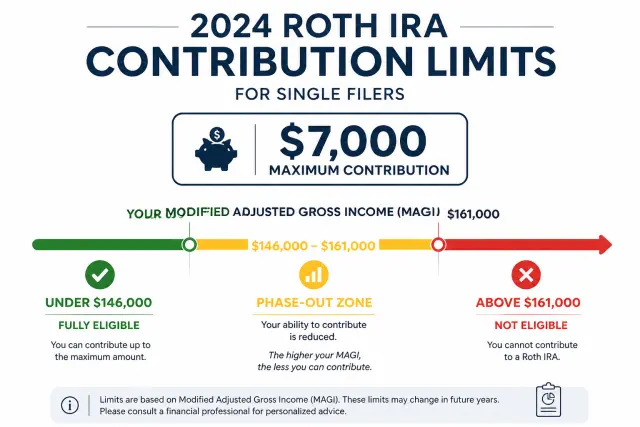
The Roth IRA's tax-free growth and withdrawal benefits are extraordinary — but they come with contribution rules that are among the most important in personal finance to understand correctly. Exceeding the annual contribution limit or contributing when your income makes you ineligible triggers a 6% excise tax on excess contributions that compounds year after year until corrected. Conversely, not maximizing contributions within the rules leaves tax-free growth on the table that can never be recovered.
Contribution limits, eligibility and catch-up rules are indexed. Check the current IRS guidance for the tax year before contributing.
Current Roth IRA limits
For 2026, the IRA contribution limit is $7,500. Direct Roth IRA eligibility and any catch-up amount depend on age, filing status, modified adjusted gross income and earned income. Use the IRS 2026 guidance before contributing.
Income limits and phase-out ranges
Direct Roth IRA eligibility depends on filing status and modified adjusted gross income. Use the IRS 2026 limits and phase-out ranges rather than prior-year figures.
Calculating a reduced contribution
Calculate a reduced Roth IRA contribution using the IRS worksheet for the current tax year. A prior-year numerical example should not be used to determine present eligibility.
Catch-Up Contributions at Age 50+
Contribution limits, eligibility and catch-up rules are indexed. Check the current IRS guidance for the tax year before contributing.
Rules, limits, eligibility and benefit calculations change by tax year and individual circumstances. Confirm the current requirement with the official source before acting.
The catch-up contribution faces the same income limits and phase-out ranges as regular contributions — high earners who are phased out of regular Roth IRA contributions are also phased out of catch-up contributions. The backdoor Roth IRA strategy equally circumvents income limits for catch-up amounts.
Rules, limits, eligibility and benefit calculations change by tax year and individual circumstances. Confirm the current requirement with the official source before acting.
Spousal IRA Contributions
The earned income requirement does not prevent a non-working or lower-earning spouse from contributing to their own IRA. The spousal IRA rule allows a married couple to contribute to both spouses' IRAs based on the working spouse's earned income, as long as the couple files a joint tax return and the household has sufficient earned income to cover both contributions.
Contribution limits, eligibility and catch-up rules are indexed. Check the current IRS guidance for the tax year before contributing.
Each spouse's IRA is their own account — the non-working spouse's IRA is titled in their name, they own it outright, and it is not a joint account. The spousal IRA simply allows using household earned income to justify both contributions. This rule is extremely valuable for households where one partner works while the other cares for children, pursues education, or is otherwise temporarily out of the workforce — it allows both spouses to build retirement savings simultaneously.
Contribution Deadline
Unlike 401(k) contributions, which must be made within the calendar year, IRA contributions can be made up to the tax filing deadline for that tax year — typically April 15 of the following year. This means:
- Current limits: Check the current IRS guidance for eligibility, contribution and catch-up rules before acting.
- If you file for a tax extension, the extension does not extend the IRA contribution deadline — April 15 is the firm deadline regardless of whether you file your return on time
- When making a contribution between January 1 and April 15 of the following year, you must designate which tax year the contribution is for — prior year or current year. Get this right, as it affects which year's limit applies and which year's Form 8606 records the contribution.
The April 15 deadline creates a useful planning opportunity: you can wait to see your actual MAGI for the year before contributing, ensuring you contribute the exactly correct amount without risk of excess contribution penalties. Alternatively, this allows making \"catch-up\" contributions in January through April if you did not contribute during the prior calendar year.
Excess Contributions: How to Fix Them
An excess contribution occurs when you contribute more than the allowable limit for the year — either more than the $7,000 cap, more than your earned income, or more than your income permits after the phase-out calculation. The penalty for excess contributions is a 6% excise tax on the excess amount per year it remains in the account — and this penalty continues accumulating every year until the excess is corrected.
If you discover an excess contribution, two correction methods are available:
Withdraw the excess plus earnings before the tax deadline: The cleanest fix is removing the excess contribution and any earnings attributable to it before the tax filing deadline (including extensions — October 15 for an extension filer, but remember April 15 applies to IRA contributions). When you withdraw a timely corrective distribution, no 6% penalty applies. The earnings portion of the withdrawal is taxable as ordinary income and may be subject to the 10% early withdrawal penalty if you are under 59½.
Recharacterize the excess as a prior-year contribution (for backdoor Roth users): If you contributed more than your income permitted, you may be able to apply the excess toward the prior year's unused IRA contribution limit, effectively converting it to a valid prior-year contribution. This is a complex maneuver that requires coordination with your IRA custodian and proper documentation.
After the deadline: If the deadline has passed without correction, you owe the 6% penalty for the year of the excess and each subsequent year the excess remains. You can still apply the excess to the current year's contribution limit — if you have contribution capacity in the current year, the excess effectively becomes your current-year contribution, ending the excise tax going forward.
Most major brokerages provide guided processes for removing excess contributions. The IRS Form 5329 is used to report and calculate the excise tax on excess contributions when they occur.
Contributing with a 401(k)
One of the most common misconceptions about Roth IRA contributions is that having a 401(k) prevents or limits Roth IRA contributions. This is incorrect — the 401(k) and Roth IRA contribution limits are entirely separate and do not affect each other.
Contribution limits, eligibility and catch-up rules are indexed. Check the current IRS guidance for the tax year before contributing.
Similarly, having a 401(k) does not affect the ability to make a non-deductible traditional IRA contribution for the backdoor Roth strategy — anyone can make a non-deductible contribution regardless of workplace plan participation. The deductibility of a traditional IRA contribution is affected by workplace plan participation, but not the ability to make a non-deductible contribution and then convert it to Roth.
Strategies to Maximize Contributions
Getting the most from the Roth IRA contribution window requires intentional planning rather than passive enrollment:
Contribute early in the year. Contributing on January 1 instead of April 15 provides 15.5 additional months of tax-free growth over a contributing lifetime. At 8% annual returns, a $7,000 contribution on January 1 grows to approximately $7,919 by April 15 of the following year — $919 more than if you waited until the deadline. Over 30 years of early contributions, this timing difference compounds to tens of thousands of dollars in additional retirement wealth.
Set up automatic monthly contributions. Automating contributions of $583/month (approximately $7,000 ÷ 12) treats the Roth IRA contribution like a monthly bill payment — non-negotiable and consistent. Dollar-cost averaging through monthly contributions also removes the timing anxiety of investing a lump sum.
Make prior-year contributions in early January. If you did not max out last year's contribution and can still do so before April 15, contribute for the prior year before contributing for the current year. This allows you to make two years' contributions in rapid succession, effectively doubling your Roth IRA funding rate temporarily.
Plan MAGI strategically if near the phase-out range. Investors with income near the Roth IRA phase-out threshold can sometimes manage their MAGI below the threshold through strategies including: maximizing pre-tax 401(k) contributions (which reduce AGI), making HSA contributions (pre-tax), timing of capital gains realization in taxable accounts, or timing of Roth conversions. A single year's worth of strategic MAGI management can make the difference between a full $7,000 Roth contribution and being completely phased out.
Use the backdoor Roth if income exceeds limits. If your MAGI consistently exceeds the Roth IRA contribution limits, the backdoor Roth IRA strategy provides year-round access to Roth benefits regardless of income — see the dedicated guide for implementation details and the critical pro-rata rule that governs whether the strategy is clean or partially taxable.
The Roth IRA's contribution limits, while modest in any single year, compound into extraordinary wealth over a working lifetime. A 25-year-old who contributes the maximum annually through retirement at 65, earning 7% average real returns, accumulates approximately $1.9 million in tax-free assets — from $280,000 in personal contributions. Understanding and adhering to the rules is the prerequisite for capturing this benefit year after year without interruption from excess contribution penalties or eligibility errors.
Sources, scope, and review
Last editorial review: October 20, 2026. This page provides general educational information, not individualized investment, tax, legal, or financial advice. Past performance does not predict future results.
Editorial responsibility: Juarez Santos. Background provided by the site owner: financial agent and real-estate management. This background does not replace individualized advice or a credentialed specialist review. When a qualified independent reviewer contributes to a page, that reviewer and their role must be identified on that page.
Disclosure requirement: Before publication, display any material affiliate, advertising, or commercial relationship relevant to this page. Do not state that a professional specialist reviewed an article unless that review can be documented.
Frequently Asked Questions
How much can I contribute to a Roth IRA in 2024?
For 2024, the Roth IRA contribution limit is $7,000 if you are under age 50, or $8,000 if you are 50 or older (including a $1,000 catch-up contribution). However, your actual maximum contribution may be lower based on two factors: your earned income for the year (you cannot contribute more than you earned) and your Modified Adjusted Gross Income, which phases out contributions for single filers above $146,000 and married couples above $230,000. These limits apply to the combined total of all your traditional and Roth IRAs.
Can I contribute to a Roth IRA if I make too much money?
Not directly — direct Roth IRA contributions are phased out for single filers earning $146,000–$161,000 and married couples earning $230,000–$240,000 in 2024. However, high earners can still access Roth IRA benefits through the backdoor Roth IRA strategy: make a non-deductible contribution to a traditional IRA (allowed regardless of income), then convert it to a Roth IRA (also allowed regardless of income). The key complexity is the pro-rata rule, which creates taxable income if you have existing pre-tax IRA balances.
What happens if I contribute too much to a Roth IRA?
Excess contributions are subject to a 6% excise tax per year the excess remains in the account. To fix an excess contribution, withdraw the excess plus any earnings attributable to it before the tax filing deadline (April 15, or October 15 with an extension). If you catch it before the deadline, the 6% penalty is avoided — only the earnings portion is taxable as ordinary income. If the deadline has passed, you owe the 6% penalty for the year and each subsequent year, but you can apply the excess toward the current year's contribution limit if you have available capacity.
Can I contribute to a Roth IRA if I have no income?
Generally no — you need earned income to contribute to a Roth IRA, and you cannot contribute more than your annual earned income. However, a non-working spouse can contribute to their own Roth IRA under the spousal IRA rules, as long as the couple files taxes jointly and the working spouse's earned income covers both contributions. For example, if one spouse works and earns $50,000 while the other does not work, both spouses can make full Roth IRA contributions ($7,000 each) as long as the household earned income ($50,000) exceeds the total IRA contributions ($14,000).