Bitcoin vs Ethereum: Key Differences for Investors
Bitcoin and Ethereum are the two dominant cryptocurrencies, but they serve fundamentally different purposes. This guide explains what makes each unique, their investment theses, risk profiles, and how to think about them in a diversified portfolio.
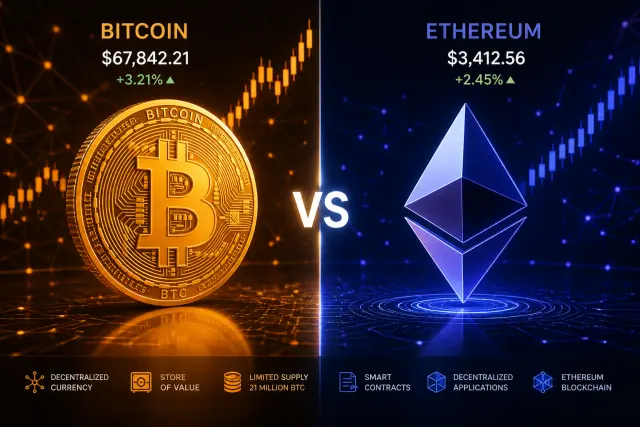
Bitcoin and Ethereum are consistently named in the same breath — the two largest cryptocurrencies by market capitalization, the most liquid, the most institutionally held, and the most likely to survive another decade of regulatory and technological change. Yet treating them as interchangeable because they are both \"crypto\" misses a fundamental distinction: they are designed to solve different problems and represent different investment theses.
Understanding the differences is essential to any deliberate cryptocurrency allocation — whether you are considering your first crypto purchase or refining an existing position. This guide examines both from an investor's perspective, covering what each actually is, how they differ technically and economically, and how to think about them as portfolio assets.
Bitcoin: Digital Gold and Store of Value
Bitcoin was created in 2009 by the pseudonymous Satoshi Nakamoto as a peer-to-peer electronic cash system. Over its 15-year history, the primary narrative has evolved from digital cash to digital gold — a decentralized store of value with properties that proponents argue make it superior to physical gold as inflation protection and wealth preservation.
Bitcoin's defining characteristics as a store of value include its absolutely fixed supply (21 million coins, period — no one can change this without destroying the network), its decentralization (no single company, government, or individual controls it), its 15-year security track record (the Bitcoin blockchain has never been successfully hacked), and its network effect — the largest, most liquid, most widely held cryptocurrency with the deepest institutional adoption.
The investment case for Bitcoin rests on several propositions. Hard cap supply of 21 million coins in a world of expanding money supply creates scarcity that gold cannot match (gold supply grows with mining investment). Its portability, divisibility, and transferability exceed gold's physical limitations. Growing institutional adoption — major corporations, ETFs, sovereign wealth funds — increases demand against fixed supply. As a non-correlated asset over longer time horizons, it can provide diversification benefits in a multi-asset portfolio.
Bitcoin does one thing exceptionally well: being Bitcoin. It is deliberately simple and unchanging, which is a strength for a store of value. The rigidity that frustrates developers who want more programmability is the same property that gives confidence in its long-term monetary policy and security model. You do not want your gold to update its software every few months.
Ethereum: Programmable Blockchain and Web3 Platform
Digital-asset regulation, fund terms, reporting and platform risks can change. Treat prior-year product information as historical and review current SEC disclosures, fund documents and tax guidance before acting.
Digital-asset regulation, fund terms, reporting and platform risks can change. Treat prior-year product information as historical and review current SEC disclosures, fund documents and tax guidance before acting.
Digital-asset regulation, fund terms, reporting and platform risks can change. Treat prior-year product information as historical and review current SEC disclosures, fund documents and tax guidance before acting.
Digital-asset regulation, fund terms, reporting and platform risks can change. Treat prior-year product information as historical and review current SEC disclosures, fund documents and tax guidance before acting.
Key Technical Differences
Consensus mechanism: Bitcoin uses Proof of Work — miners compete to solve computational puzzles, consuming significant energy. This energy consumption is both a criticism (environmental impact) and a security feature (the cost of attacking the network is enormous). Ethereum uses Proof of Stake — validators lock up ETH as collateral to participate in block validation. PoS uses approximately 99% less energy than PoW and enables faster transactions. Critics argue PoS introduces different security trade-offs.
Transaction speed and cost: Bitcoin processes approximately 7 transactions per second (TPS) with average transaction costs of $1–$30 depending on network congestion. Ethereum processes approximately 15–30 TPS on the base layer, with similar gas fee variability. Layer 2 scaling solutions (Arbitrum, Optimism, Base) extend Ethereum's capacity to thousands of TPS at fractions of a cent per transaction. Bitcoin's Lightning Network provides a comparable Layer 2 solution for payments.
Smart contract capability: Bitcoin has very limited programmability — its scripting language is deliberately simple and not Turing-complete. Ethereum is fully programmable — any application that can be described in code can theoretically be deployed on Ethereum. This is the foundational distinction between the two platforms.
Supply mechanics: Bitcoin: 21 million hard cap; currently ~19.7 million mined; new supply issued via mining at a rate that halves approximately every four years. Ethereum: No hard cap, but currently deflationary in most conditions via fee burning; total supply around 120 million ETH.
Investment Thesis Comparison
Understanding the investment thesis for each asset clarifies why they behave differently and why investors choose one versus the other:
Bitcoin investment thesis: Bitcoin is digital gold — a scarce, decentralized store of value that will appreciate as more investors allocate a percentage of portfolios to it the way they allocate to gold. The bull case is adoption: if Bitcoin captures even 5–10% of the gold market, its price would be multiples higher. If it becomes a mainstream reserve asset for institutional portfolios and sovereign wealth funds, the price appreciation potential is substantial. The bear case: Bitcoin is slow to evolve, limited in utility beyond value transfer, and competes against other assets for the \"digital gold\" narrative if better alternatives emerge.
Ethereum investment thesis: Ethereum is the foundational layer for decentralized applications and Web3 — analogous to owning a stake in the internet's operating system rather than a specific website. The bull case: as DeFi, NFTs, tokenized real-world assets, and decentralized applications grow, demand for ETH to pay transaction fees grows proportionally. If the digital economy moves meaningfully on-chain, ETH is the denomination of that economy. The bear case: Ethereum faces competition from faster, cheaper Layer 1 blockchains (Solana, Avalanche, etc.) that could capture developer and user activity; regulatory risk around smart contracts and DeFi is less settled than for Bitcoin; and the technology roadmap complexity introduces execution risk.
These theses serve different investor needs and behave somewhat differently across market cycles — though both are highly correlated to general crypto sentiment during broad market movements.
Supply Economics: Scarcity vs. Utility
Bitcoin and Ethereum represent two distinct economic models for a digital asset:
Bitcoin's scarcity model: The value case rests on absolute scarcity combined with increasing demand. The 21 million supply cap is enforced by cryptographic protocol and network consensus — it cannot be changed without the agreement of the vast majority of all network participants worldwide, a practical impossibility given the diversity and distribution of Bitcoin stakeholders. Each halving event (approximately every four years) reduces new supply by 50%, creating recurring supply shocks that have historically correlated with price appreciation cycles. Bitcoin's monetary policy is more predictable than any central bank's — you can calculate exactly how much Bitcoin will exist in 2050 today.
Ethereum's utility model: ETH's value derives from its necessity as the fuel for Ethereum network operations. Every DeFi transaction, NFT mint, DAO governance vote, and smart contract interaction requires ETH to pay gas fees. Higher network utilization increases gas consumption, which increases ETH burned under EIP-1559, which reduces supply. In periods of high network usage (DeFi booms, NFT surges, Layer 2 adoption), Ethereum can be net deflationary — more ETH is destroyed by usage than is created by staking rewards. The value case is therefore tied to actual utility and adoption of the Ethereum ecosystem rather than pure monetary scarcity.
Neither model is inherently superior — they are different. Bitcoin's model is more conservative and requires less ongoing development success. Ethereum's model ties value directly to ecosystem growth, providing more upside if Web3 adoption accelerates and more downside if competitors successfully challenge Ethereum's ecosystem position.
Risk Profiles Compared
Both assets carry the high-volatility, regulatory-uncertainty, and nascent-technology risks common to all cryptocurrencies. Within that shared risk landscape, they have distinct additional risk factors:
Bitcoin-specific risks: Bitcoin's simplicity is its strength but also a limitation — if a clearly superior store-of-value alternative emerges that captures institutional attention, Bitcoin's network effect moat could erode. Quantum computing advances could theoretically threaten Bitcoin's cryptographic security over very long time horizons (though the same applies to all cryptographic systems, including banking infrastructure). Regulatory classification risk — if major governments classify Bitcoin as a security rather than a commodity, institutional adoption and market access could be significantly constrained.
Digital-asset regulation, fund terms, reporting and platform risks can change. Treat prior-year product information as historical and review current SEC disclosures, fund documents and tax guidance before acting.
Institutional and Regulatory Status
Digital-asset regulation, fund terms, reporting and platform risks can change. Treat prior-year product information as historical and review current SEC disclosures, fund documents and tax guidance before acting.
Digital-asset regulation, fund terms, reporting and platform risks can change. Treat prior-year product information as historical and review current SEC disclosures, fund documents and tax guidance before acting.
Digital-asset regulation, fund terms, reporting and platform risks can change. Treat prior-year product information as historical and review current SEC disclosures, fund documents and tax guidance before acting.
How Each Fits in a Portfolio
For investors who have decided to include cryptocurrency in their portfolio, the Bitcoin vs. Ethereum question often reduces to: which one first, and in what proportion?
Most financial advisors who include crypto suggest starting with Bitcoin. The reasons are practical: better regulatory clarity, longer institutional track record, simpler investment thesis, and the most liquid spot ETF market. For investors who want cryptocurrency exposure with the most established risk framework, Bitcoin-only is a defensible position.
Ethereum makes sense as the second allocation for investors who want broader cryptocurrency exposure and believe in the long-term growth of decentralized applications. The correlation between Bitcoin and Ethereum is high (both fall sharply in crypto bear markets), so the diversification benefit of holding both within the crypto allocation is meaningful but not dramatic. The primary benefit of adding Ethereum is participation in the Web3 ecosystem growth thesis that Bitcoin does not provide.
A common allocation framework among crypto-inclusive investors: Bitcoin as the larger, more conservative position (perhaps 60–70% of the crypto allocation), Ethereum as the second position (20–30%), and any additional allocations to smaller cryptocurrencies kept below 10–20% total given their substantially higher risk. The overall crypto allocation — Bitcoin plus Ethereum plus any others — should be sized such that a 90% decline in the crypto portfolio would not materially impair your overall financial plan.
Both Bitcoin and Ethereum deserve serious consideration from investors who choose to include cryptocurrency in their portfolios — not as equivalent assets, but as distinct instruments serving different investment theses. Understanding those theses, rather than simply following price performance, is the foundation of any deliberate crypto allocation strategy.
Sources, scope, and review
Last editorial review: October 20, 2026. This page provides general educational information, not individualized investment, tax, legal, or financial advice. Past performance does not predict future results.
Editorial responsibility: Juarez Santos. Background provided by the site owner: financial agent and real-estate management. This background does not replace individualized advice or a credentialed specialist review. When a qualified independent reviewer contributes to a page, that reviewer and their role must be identified on that page.
Disclosure requirement: Before publication, display any material affiliate, advertising, or commercial relationship relevant to this page. Do not state that a professional specialist reviewed an article unless that review can be documented.
Frequently Asked Questions
Should I buy Bitcoin or Ethereum first?
For most investors making their first cryptocurrency purchase, Bitcoin is the conventional starting point — it has better regulatory clarity (classified as a commodity), the most developed institutional infrastructure including spot ETFs, a simpler and more proven investment thesis (digital gold/store of value), and the longest track record. Ethereum makes sense as a second allocation for investors who want exposure to the Web3 ecosystem thesis. Both carry high volatility and uncertainty; invest only what you can afford to lose entirely.
Is Bitcoin or Ethereum a better long-term investment?
Neither is universally better — they serve different investment theses. Bitcoin's bull case is adoption as a global store of value and reserve asset (digital gold). Ethereum's bull case is becoming the foundational infrastructure for a decentralized internet economy (Web3 operating system). Which performs better long-term depends on which thesis materializes more fully — and that outcome is genuinely uncertain. Most serious crypto investors hold both in proportion to their conviction on each thesis.
What is the main difference between Bitcoin and Ethereum?
The most fundamental difference: Bitcoin is primarily a monetary asset (store of value, inflation hedge, digital gold) while Ethereum is primarily a technology platform (programmable blockchain for decentralized applications). Bitcoin has a hard supply cap of 21 million coins; Ethereum has no hard cap but is often deflationary through fee burning. Bitcoin uses energy-intensive Proof of Work; Ethereum uses energy-efficient Proof of Stake. Bitcoin is deliberately simple and unchanging; Ethereum is actively evolving with a complex development roadmap.
Are Bitcoin and Ethereum correlated?
Yes, significantly — especially during broader crypto market moves. When cryptocurrency markets fall sharply (bear markets), Bitcoin and Ethereum typically fall together and often by similar percentages. Over shorter time frames, they trade with high correlation to general crypto sentiment. Over longer periods and within bull cycles, Ethereum has sometimes significantly outperformed Bitcoin (ETH captured more of the DeFi and NFT boom) and sometimes underperformed. The correlation means holding both does not provide as much diversification within the crypto allocation as it might appear.