Cryptocurrency Investing Basics for Beginners
Cryptocurrency has moved from the fringes to mainstream investing. This beginner's guide explains how crypto works, the major coins, how to buy and store it safely, and how to approach it with a risk framework that protects your broader financial plan.
Digital-asset regulation, fund terms, reporting and platform risks can change. Treat prior-year product information as historical and review current SEC disclosures, fund documents and tax guidance before acting.
The truth, as with most things in finance, is more nuanced. Cryptocurrency is a genuinely novel asset class with unique characteristics, meaningful risks, and legitimate portfolio applications for investors who understand what they own. This guide provides the foundation: how it works, what the major assets are, how to buy and store it, how to evaluate the risks, and how to integrate it sensibly into a broader investment plan.
How Cryptocurrency Works
Blockchain Technology
At the foundation of every major cryptocurrency is a blockchain — a distributed ledger that records all transactions across a network of thousands of computers simultaneously. Unlike a traditional bank database controlled by a single company, a blockchain has no central authority. Transactions are verified by network participants through a consensus mechanism (the two most common being Proof of Work and Proof of Stake) and permanently recorded in chronological blocks that are cryptographically linked to previous blocks — making the historical record effectively tamper-proof.
Digital-asset regulation, fund terms, reporting and platform risks can change. Treat prior-year product information as historical and review current SEC disclosures, fund documents and tax guidance before acting.
Decentralization
Digital-asset regulation, fund terms, reporting and platform risks can change. Treat prior-year product information as historical and review current SEC disclosures, fund documents and tax guidance before acting.
Proof of Work vs. Proof of Stake
Digital-asset regulation, fund terms, reporting and platform risks can change. Treat prior-year product information as historical and review current SEC disclosures, fund documents and tax guidance before acting.
Major Cryptocurrencies: What They Are and Do
Bitcoin (BTC)
Bitcoin is the original cryptocurrency, created by the pseudonymous Satoshi Nakamoto in 2009. It is the largest cryptocurrency by market capitalization and the most widely held by institutional investors. Bitcoin has a hard-capped supply of 21 million coins — no more can ever be created — which is the foundation of its store-of-value narrative (often called \"digital gold\"). New Bitcoin is created through mining at a rate that halves approximately every four years (the \"halving\"), with the last Bitcoin estimated to be mined around 2140.
Digital-asset regulation, fund terms, reporting and platform risks can change. Treat prior-year product information as historical and review current SEC disclosures, fund documents and tax guidance before acting.
Ethereum (ETH)
Digital-asset regulation, fund terms, reporting and platform risks can change. Treat prior-year product information as historical and review current SEC disclosures, fund documents and tax guidance before acting.
Digital-asset regulation, fund terms, reporting and platform risks can change. Treat prior-year product information as historical and review current SEC disclosures, fund documents and tax guidance before acting.
Stablecoins
Stablecoins are cryptocurrencies designed to maintain a stable value — typically pegged 1:1 to the U.S. dollar. The most widely used stablecoins are USDC (issued by Circle, fully backed by U.S. dollars and short-term Treasuries) and USDT (Tether). Stablecoins allow crypto users to move value within the crypto ecosystem without conversion to fiat currency, providing stability in an otherwise volatile market. They also enable DeFi applications, cross-border payments, and yield-earning opportunities in crypto lending protocols.
Other Altcoins
Beyond Bitcoin and Ethereum, thousands of alternative cryptocurrencies (\"altcoins\") exist. The higher-market-cap altcoins — Solana (SOL), BNB, XRP, Cardano (ADA), Avalanche (AVAX) — have real development communities, distinct technical approaches, and genuine use cases. The vast majority of lower-cap altcoins are highly speculative, many are outright scams, and most will eventually lose most or all of their value. Beginners should approach altcoins with extreme caution and limit exposure to the most established projects until they have built a solid understanding of the space.
How to Buy Cryptocurrency
Centralized Exchanges
Digital-asset regulation, fund terms, reporting and platform risks can change. Treat prior-year product information as historical and review current SEC disclosures, fund documents and tax guidance before acting.
Digital-asset regulation, fund terms, reporting and platform risks can change. Treat prior-year product information as historical and review current SEC disclosures, fund documents and tax guidance before acting.
Through a Brokerage
Digital-asset regulation, fund terms, reporting and platform risks can change. Treat prior-year product information as historical and review current SEC disclosures, fund documents and tax guidance before acting.
Decentralized Exchanges
Digital-asset regulation, fund terms, reporting and platform risks can change. Treat prior-year product information as historical and review current SEC disclosures, fund documents and tax guidance before acting.
Storing Crypto Safely: Wallets Explained
Digital-asset regulation, fund terms, reporting and platform risks can change. Treat prior-year product information as historical and review current SEC disclosures, fund documents and tax guidance before acting.
Custodial Wallets (Exchange Accounts)
Digital-asset regulation, fund terms, reporting and platform risks can change. Treat prior-year product information as historical and review current SEC disclosures, fund documents and tax guidance before acting.
Software Wallets (Hot Wallets)
Digital-asset regulation, fund terms, reporting and platform risks can change. Treat prior-year product information as historical and review current SEC disclosures, fund documents and tax guidance before acting.
Hardware Wallets (Cold Storage)
Digital-asset regulation, fund terms, reporting and platform risks can change. Treat prior-year product information as historical and review current SEC disclosures, fund documents and tax guidance before acting.
Risk Framework for Crypto Investors
Digital-asset regulation, fund terms, reporting and platform risks can change. Treat prior-year product information as historical and review current SEC disclosures, fund documents and tax guidance before acting.
Digital-asset regulation, fund terms, reporting and platform risks can change. Treat prior-year product information as historical and review current SEC disclosures, fund documents and tax guidance before acting.
Digital-asset regulation, fund terms, reporting and platform risks can change. Treat prior-year product information as historical and review current SEC disclosures, fund documents and tax guidance before acting.
Digital-asset regulation, fund terms, reporting and platform risks can change. Treat prior-year product information as historical and review current SEC disclosures, fund documents and tax guidance before acting.
Digital-asset regulation, fund terms, reporting and platform risks can change. Treat prior-year product information as historical and review current SEC disclosures, fund documents and tax guidance before acting.
Digital-asset regulation, fund terms, reporting and platform risks can change. Treat prior-year product information as historical and review current SEC disclosures, fund documents and tax guidance before acting.
How Much to Allocate
There is no universally right answer to crypto allocation, but there is a widely shared framework among financial professionals who include it in portfolios: size the position such that its complete loss would not materially impair your overall financial plan.
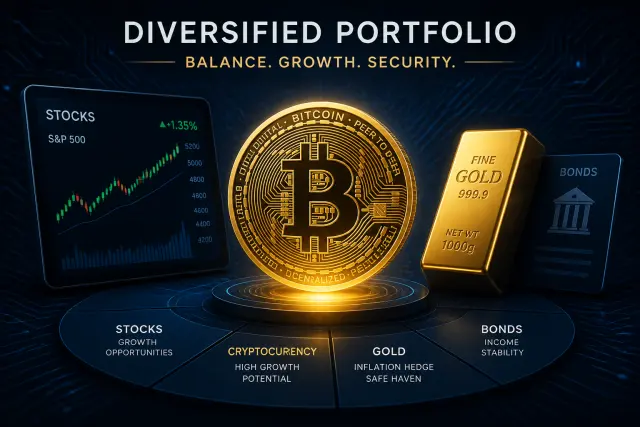
For most investors with a traditional investment portfolio (index funds, bonds, retirement accounts), a crypto allocation of 1–5% of total invested assets is a commonly cited range. This provides meaningful upside participation in crypto's potential appreciation — if Bitcoin doubles, a 5% allocation contributes 5 percentage points to your total portfolio return — while limiting downside exposure to a manageable amount if the position goes to zero.
Investors who understand the technology deeply, have a longer time horizon for their crypto position specifically, and are willing to accept significant volatility may rationally hold more. Investors approaching retirement or who have lower overall risk tolerance may choose less or none at all. There is no obligation to hold any crypto; a 100% index fund portfolio is a perfectly sound investment strategy.
Within a crypto allocation, most risk-conscious investors concentrate the majority in Bitcoin (the most established, most liquid, most institutionally held cryptocurrency) with smaller allocations to Ethereum and, if desired, a small speculative allocation to higher-risk altcoins. Diversifying across 20 different altcoins provides no meaningful diversification — most altcoins are highly correlated and fall together in risk-off environments.
Crypto Taxes in the United States
Digital-asset regulation, fund terms, reporting and platform risks can change. Treat prior-year product information as historical and review current SEC disclosures, fund documents and tax guidance before acting.
Digital-asset regulation, fund terms, reporting and platform risks can change. Treat prior-year product information as historical and review current SEC disclosures, fund documents and tax guidance before acting.
Digital-asset regulation, fund terms, reporting and platform risks can change. Treat prior-year product information as historical and review current SEC disclosures, fund documents and tax guidance before acting.
Digital-asset regulation, fund terms, reporting and platform risks can change. Treat prior-year product information as historical and review current SEC disclosures, fund documents and tax guidance before acting.
Holding Bitcoin or Ethereum ETFs in a Roth IRA is an exception: within the IRA, trades are not taxable events. This makes the Roth IRA one of the most tax-efficient structures for long-term crypto exposure — all appreciation is eventually tax-free, and the complex transaction-level tracking required for direct crypto ownership is eliminated entirely.
Cryptocurrency is a legitimate asset class with genuine portfolio applications and real risks. Approached with appropriate position sizing, a long time horizon, proper security practices, and tax awareness, it can be a thoughtful complement to a traditional investment portfolio. Approached as a get-rich-quick vehicle with money you cannot afford to lose, it destroys wealth far more reliably than it creates it.
Sources, scope, and review
Last editorial review: October 20, 2026. This page provides general educational information, not individualized investment, tax, legal, or financial advice. Past performance does not predict future results.
Editorial responsibility: Juarez Santos. Background provided by the site owner: financial agent and real-estate management. This background does not replace individualized advice or a credentialed specialist review. When a qualified independent reviewer contributes to a page, that reviewer and their role must be identified on that page.
Disclosure requirement: Before publication, display any material affiliate, advertising, or commercial relationship relevant to this page. Do not state that a professional specialist reviewed an article unless that review can be documented.
Frequently Asked Questions
Is cryptocurrency a good investment for beginners?
It can be, with appropriate expectations and position sizing. A small allocation (1–5% of your total portfolio) to Bitcoin or Ethereum through a reputable exchange or ETF can provide exposure to a genuinely novel asset class without material risk to your overall financial plan. Bitcoin's historical return profile has been among the strongest of any asset class, though with extreme volatility. Beginners should start with the most established assets (Bitcoin first, Ethereum second), never invest more than they can afford to lose entirely, and ensure traditional retirement savings and emergency fund foundations are in place before adding crypto.
What is the safest way to buy Bitcoin?
For most beginners, buying a Bitcoin ETF (IBIT from BlackRock, FBTC from Fidelity) through an existing brokerage account is the safest and most familiar approach — no new exchange accounts, no wallet management, SEC-regulated. For those who want direct Bitcoin ownership, using a large regulated U.S. exchange like Coinbase or Kraken, enabling two-factor authentication, and transferring larger amounts to a hardware wallet (Ledger, Trezor) provides the best security combination. Never buy Bitcoin on unknown platforms, from strangers, or in response to unsolicited investment advice.
Can I lose all my money in cryptocurrency?
Yes — this is a genuine possibility, especially for altcoins, and even for major assets in scenarios involving exchange failure or lost wallet access. Bitcoin has never gone to zero, but it has fallen 85% from peak to trough during bear markets. The complete loss scenario is most likely through: exchange failure (FTX 2022), lost wallet access/seed phrase, scam or phishing attack, or investing in fraudulent projects. Only invest amounts you could afford to lose completely without impairing your financial security.
Do I need to report cryptocurrency on my taxes if I didn't sell?
If you only bought cryptocurrency and still hold it without selling, trading, or using it, you generally do not have a taxable event to report (though you must still answer 'yes' to the digital asset question on your 1040 if you received crypto as income, regardless of disposition). Taxable events occur when you sell, trade, spend, or receive crypto as income. Unrealized gains on holdings you have not sold are not currently taxable in the U.S. Keep records of your purchase dates and prices (cost basis) for every acquisition to accurately calculate gains when you eventually sell.